




Cash on deliveryPay when it arrives
Free shippingOn orders over Rs. 2,000
Fast delivery2–4 working days in major cities
14-day money-backIf it doesn't suit your skin
Buying guide
About Sunscreens
Broad-spectrum SPF 50 and SPF 70, Rs. 1,200 each for 120ml. Lightweight enough to wear daily in Lahore and Karachi heat — which matters more than the number on the tube, because the best sunscreen in Pakistan is the one you'll actually keep using.
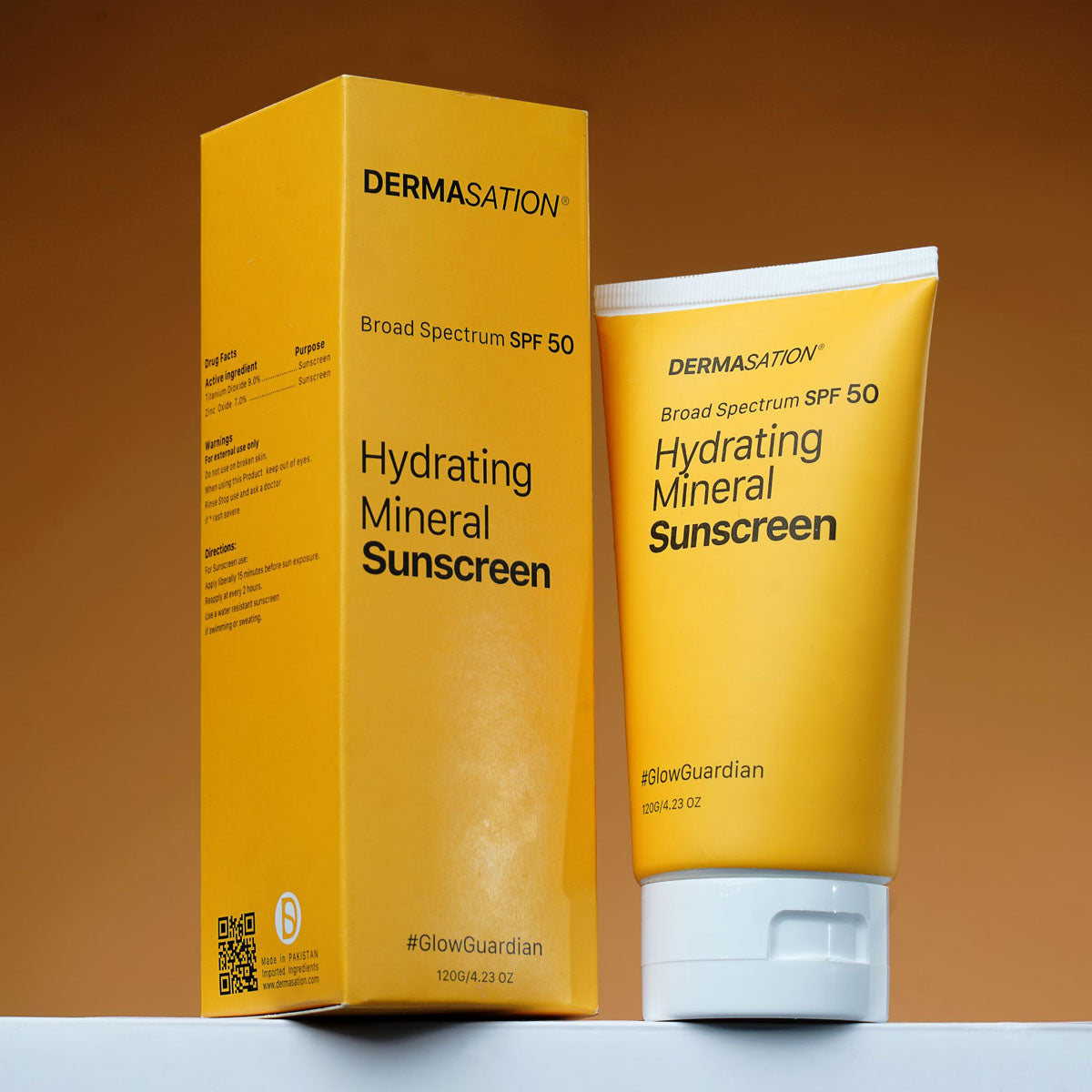
Hydrating Sunscreen SPF 50 — 120ml · Rs. 1,200
The one most people should buy
Blocks 98% of UVB with full broad-spectrum UVA coverage. Lightweight, non-greasy, and formulated to leave minimal white cast on medium to deep South Asian skin tones. Sits under makeup through a full working day.
- Broad-spectrum SPF 50, UVA + UVB
- Non-comedogenic — won't clog pores
- Oil-free finish, no greasy residue
- 120ml — enough to reapply properly rather than ration
Best for: daily wear, office and commute, oily and combination skin, year-round use
Hydrating Sunscreen SPF 70 — 120ml · Rs. 1,200
For long stretches outdoors
Blocks 98.6% of UVB. Same lightweight base, with a higher margin and better sweat resistance for outdoor work, sport, and travel to the north.
- Advanced broad-spectrum SPF 70
- Sweat-resistant through heat and activity
- No thick or paste-like texture
- 120ml
Best for: outdoor sport, fieldwork, travel to Hunza, Skardu or Murree, peak summer
SPF 50 or SPF 70?
| SPF 50 | SPF 70 | |
|---|---|---|
| UVB blocked | 98% | 98.6% |
| Office and commute | Ideal | More than enough |
| Outdoor sport | Adequate for short exposure | Recommended |
| High-altitude travel | UV intensifies at altitude | Recommended |
| Sweat resistance | Standard | Enhanced |
| Non-comedogenic | Yes | Yes |
| Price | Rs. 1,200 | Rs. 1,200 |
Same price, so it comes down to how you spend your day. Mostly indoors with a commute either side — SPF 50. Outside for hours at a time — SPF 70.
Sunscreen for Oily Skin
If you've given up on SPF because everything felt like a layer of grease by noon, that's a texture problem, not a reason to skip protection.
Both formulas are non-comedogenic and finish light rather than tacky. Skin that runs oily is often dehydrated underneath, so a hydrating formula tends to sit better through the day than a heavy mattifying one. Blot first, then reapply over the top — that keeps the finish clean without adding another layer of powder.
How to Apply Sunscreen
Most people use about a quarter of what's needed, which is how an SPF 50 ends up performing like an SPF 15.
On your face: use roughly two finger-lengths — squeezed along your index and middle finger — for face and neck together. Dot it across forehead, cheeks, nose and chin, then spread evenly rather than rubbing until it vanishes. Don't skip ears, hairline, and the back of the neck.
SPF 50: every morning as the final step, after moisturizer and before makeup. Reapply every 2 hours outdoors.
SPF 70: 15 minutes before heading out. Reapply every 90 minutes during prolonged exposure or after sweating.
One rule that doesn't bend: if you use Glycolic Acid or Retinol, SPF is mandatory every single morning. Exfoliating acids make skin measurably more sensitive to UV.
Why SPF Isn't a Summer Product
- UVA — behind dark spots, melasma and premature aging — passes through cloud and glass all year, including winter
- UVB causes sunburn and surface damage, strongest in summer but present daily
- Indoors still counts — UVA reaches you through car and office windows
- UV Index in Lahore, Karachi, Multan and Islamabad regularly hits 10–12 from April through September
Pair It With Your Routine
Both are available bundled with the Glycolic Acid 7% Toner in our Repair & Protect Bundles, at a lower combined price than buying separately. Exfoliate at night, protect in the morning.
Frequently Asked Questions
What is the best sunscreen in Pakistan?
The one you'll wear every day. For most people that means a broad-spectrum SPF 50 that's light enough for local heat — a high SPF you skip on humid days protects you less than an SPF 50 you apply consistently. Both options here are Rs. 1,200 for 120ml.
What is the best sunscreen for oily skin in Pakistan?
A non-comedogenic formula with an oil-free finish. Heavy or greasy textures are the usual reason oily skin abandons sunscreen altogether, so texture matters more than any single ingredient.
What is a reasonable sunscreen price in Pakistan?
Locally made broad-spectrum SPF runs roughly Rs. 700–1,800 for a full-size bottle. Imported equivalents cost two to three times that, which is what makes daily reapplication hard to sustain. Both of these are Rs. 1,200 for 120ml.
Is SPF 50 enough in Pakistan?
For daily indoor-outdoor use, yes. SPF 50 blocks 98% of UVB. SPF 70 blocks 98.6% — a small difference that matters mainly for extended outdoor exposure or high-altitude travel.
What is the difference between sunscreen and sunblock?
In everyday use the terms are interchangeable, and regulators in most markets no longer permit "sunblock" on labels because no product blocks all UV. What actually matters is broad-spectrum coverage against both UVA and UVB, and applying enough of it.
What does broad-spectrum mean?
Protection against both UVB, which burns the skin surface, and UVA, which penetrates deeper and drives pigmentation and aging. An SPF number alone only describes UVB protection, so broad-spectrum is the part to check.
Does sunscreen help with pigmentation?
It's the single most important step. UV exposure deepens existing dark spots faster than any active can fade them, so without daily SPF a brightening routine works against itself.
Is this suitable for men?
Yes. Skin type matters, gender doesn't. The SPF 50 suits most daily use; the SPF 70 suits outdoor work and sport.
Does it leave a white cast?
Both are formulated to minimize white cast on medium to deep South Asian skin tones.
How often should I reapply?
Every 2 hours outdoors with SPF 50; every 90 minutes with SPF 70 during sustained activity. Indoors away from windows, once in the morning is generally enough.