Glycolic Acid Side Effects: What's Normal and What Isn't
In shortWhich glycolic acid side effects are normal, which mean you're overusing it, and how to avoid them. Plus purging, pregnancy and concentration.
Glycolic acid is one of the most effective ingredients you can buy without a prescription. It's also the one people most often abandon after three weeks, convinced it doesn't suit them.
Usually it did suit them. They just used it too often, too soon, or without the two things that make it tolerable.
Here's what actually happens, what's normal, what isn't, and what to do about it.
What Glycolic Acid Does to Your Skin
Glycolic acid is an alpha hydroxy acid (AHA). It works by dissolving the bonds that hold dead skin cells to the surface, so they shed faster than they would on their own.
That's the entire mechanism, and every side effect follows from it. You're accelerating something your skin already does. Push too hard and the surface comes off faster than the barrier underneath can cope with.
Which is why almost every problem below has the same solution: use it less often.
Normal Side Effects
Mild tingling on application
A brief prickle for thirty seconds or so after applying is expected. It's the acid working, and it should settle quickly.
Not normal: stinging that lasts several minutes, or burns rather than tingles.
Slight dryness in the first two weeks
Your skin is shedding faster than usual while the barrier adjusts. Some tightness is common, particularly if you're not moisturising properly afterwards.
What to do: apply moisturizer within a few minutes of the toner, every single time. Not optional — it's the difference between an adjustment period and an ongoing problem.
Light flaking
Small, fine flakes in the first fortnight are the dead cells leaving. It should stop as your skin finds its rhythm.
Not normal: sheets of peeling skin, or flaking that's still happening at week six.
Increased sun sensitivity
This one doesn't go away with time. Glycolic acid makes skin measurably more vulnerable to UV for several days after each use — studies have shown increased sunburn susceptibility that persists for around a week after stopping.
In Pakistan, where the UV Index sits at 10–12 through summer, this matters more than in most markets. Daily sunscreen isn't a suggestion here; it's the condition on which everything else works.
Side Effects That Mean You're Overdoing It
These aren't your skin adjusting. They're your barrier telling you to stop.
- Persistent redness lasting more than an hour after use
- Burning or stinging rather than a brief tingle
- Skin that suddenly reacts to products it handled fine a month ago
- Tightness that never resolves, no matter how much moisturizer you apply
- A shiny, waxy look — over-exfoliated skin, not glowing skin
- Peeling in sheets rather than fine flakes
If you recognise two or more of these, stop using acids entirely for a week. Cleanse gently, moisturize, wear sunscreen, and let the barrier rebuild. Then restart at half the frequency you were on.
Can Glycolic Acid Cause Breakouts?
Sometimes, temporarily, and it's worth understanding why.
Faster cell turnover brings congestion that was already forming to the surface sooner than it would have arrived on its own. Spots that were going to appear in three weeks appear in one instead. That's purging, and it typically settles by week six.
How to tell purging from irritation:
- Purging happens where you normally break out, clears faster than usual, and improves after four to six weeks
- Irritation appears in new places, comes with redness or stinging, and keeps getting worse
If it's still deteriorating past week six, it's not purging. Cut back.
Is Glycolic Acid Safe During Pregnancy?
Glycolic acid is generally considered lower-risk than retinoids, which are clearly contraindicated. Topical AHAs are absorbed minimally, and many dermatologists consider low-concentration glycolic acid acceptable during pregnancy.
That said, this is a question for your doctor rather than a skincare article or a product page. Pregnancy skincare advice varies, and a general guideline is no substitute for someone who knows your circumstances.
If you'd rather avoid it entirely, niacinamide and vitamin C address similar concerns and are widely considered pregnancy-safe — again, worth confirming with your doctor.
Who Should Be Careful
- Very sensitive or reactive skin — patch test first, start at one evening a week
- Compromised barrier — if your skin is already tight, red or stinging, repair it before adding an acid
- Active eczema, rosacea or dermatitis — speak to a dermatologist first
- Anyone using retinol — fine to use both, never on the same night
- Sunburnt, broken or irritated skin — wait until it's healed
How to Use Glycolic Acid Without the Side Effects
Most problems come from four mistakes. Avoid them and the vast majority of people tolerate glycolic acid without issue.
1. Start at twice a week
Not every night. Not every other night. Two evenings a week for the first month, then build to a maximum of three or four. There is no version of this where daily use produces faster results — it produces irritation, and irritated skin looks worse than untreated skin.
2. Moisturize immediately after
Exfoliation depletes ceramides, the lipids holding your barrier together. Replacing them is what makes long-term use sustainable. Apply moisturizer within a few minutes of the acid, every time.
3. Wear sunscreen every morning
Non-negotiable, for two reasons. Glycolic acid increases UV sensitivity, and UV deepens the pigmentation you're presumably trying to fade. Without daily SPF, you're removing pigment at night and creating it by day.
4. Don't stack it with other actives
Never the same night as retinol — alternate them. Keep vitamin C to the morning. And don't use a physical scrub on an acid evening; pick one form of exfoliation per night.
Does Concentration Matter?
Yes, considerably. Over-the-counter glycolic acid typically runs from 5% to 10%, and most reported side effects come from the higher end or from professional-strength peels used at home.
Professional peels start around 20% and go well beyond. Those belong in a clinic — at-home peel kits at those concentrations are the most common cause of genuine chemical burns from AHAs.
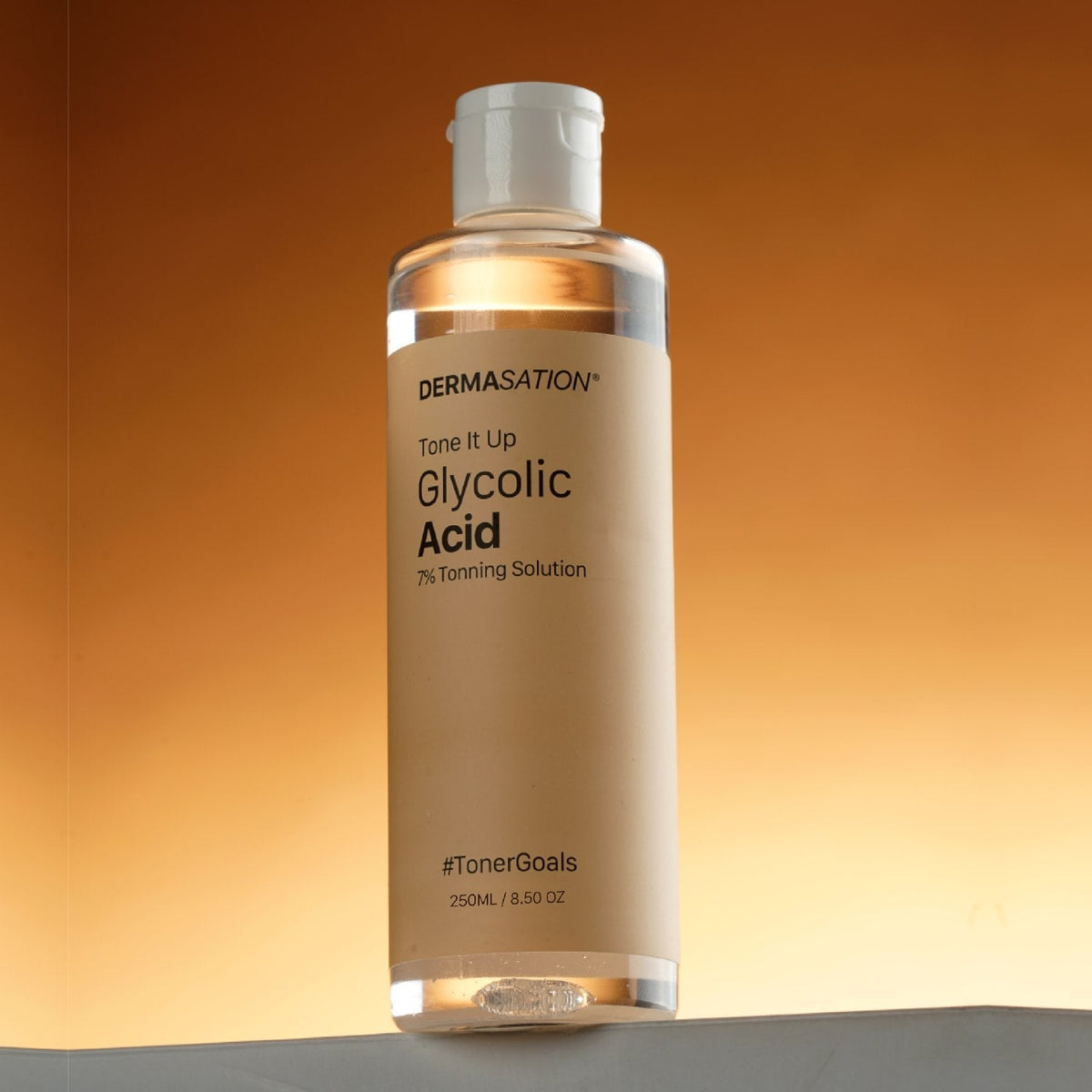
Our Glycolic Acid 7% Toning Solution sits deliberately in the effective-but-tolerable range: strong enough to produce visible change in two to three weeks, below the level where sensitisation risk climbs sharply.
What to Do If You've Overdone It
- Stop all acids and retinol for at least seven days
- Simplify to three products — gentle cleanser, moisturizer, sunscreen
- Avoid hot water, which strips lipids faster than any cleanser
- Skip physical exfoliation entirely until the skin feels normal
- Restart at half your previous frequency once tightness and redness have gone
Barrier repair is one of the faster things to respond in skincare — most people feel a difference within a week or two.
The Short Version
Glycolic acid's side effects are almost entirely dose-dependent. Twice a week with moisturizer and daily sunscreen, most people have no problems at all. Every night with neither, most people have several.
The ingredient rarely turns out to be the issue. The frequency usually is.
This article is general information, not medical advice. If you have a diagnosed skin condition, are pregnant, or your skin reacts badly to a product, speak to a doctor or dermatologist.
Read more: how glycolic acid works · shop the 7% toner · sunscreen